← Back to blog
Methodology
August 29, 2026
Updated August 29, 2026
9 min
Author: Sergey Semenov, Founder and CEO of RECOMO
AI Insights
Key takeaway
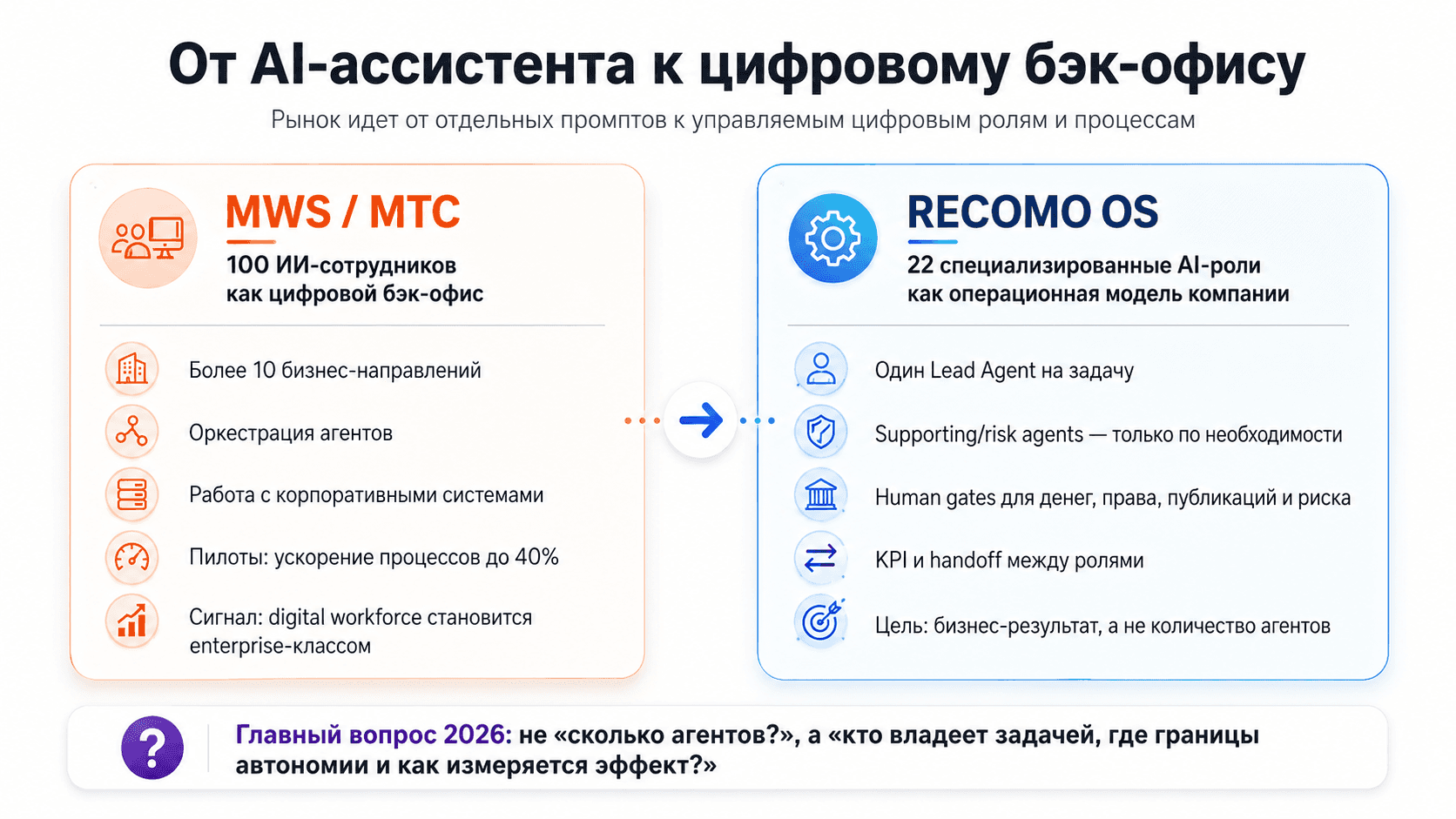
MWS is building a digital back office of 100 AI employees. RECOMO is creating its own operating model with 22 specialized AI roles. We break down why the future of enterprise AI is not about the number of agents, but about processes, orchestration, human gates, and measurable results.
Read time
9 min
Category
Methodology
Publication date
August 29, 2026
Last updated
August 29, 2026
In 2026, Enterprise AI Changes the Core Question
Until recently, companies were asking: which model to connect, which chatbot to choose, and which employees should get AI access.
Now the question is different: which roles can be digitized, how to hand off tasks between them, where to keep humans in the loop, and how to prove economic impact.
That is why the news about MTS Web Services building a digital back office of 100 AI employees matters—not because of the number 100 itself. It highlights a market shift from isolated AI features to a new operational business architecture.
At RECOMO, we are moving in the same direction from a different starting point: internally, we have formalized the RECOMO OS operating model consisting of 22 specialized AI roles.
In both cases, the core design focus is no longer a chat prompt. It is work, responsibility, permissions, boundaries, and measurable outcomes.
Why This Shift Is Happening Across the Market Now
In May 2026, MTS Web Services announced the launch of a "Virtual Employee Family" across more than ten business functions—including finance, customer service, legal, engineering, HR, and accounting.
MWS explicitly emphasized orchestration: digital employees must not merely execute isolated commands; they must receive tasks, transfer context, and operate within structured process sequences. According to the company, pilot deployments accelerated specific workflows by up to 40%, depending on the business function.
The next step is a digital back office powered by 100 AI employees.
The headline figure is not the point. What matters is the transition from "agents as a feature" to "agents as a department."
And a department requires:
roles and responsibilities;
collaboration rules;
data access governance;
quality control;
task routing;
autonomy boundaries;
KPIs;
human exception handling.
While companies spent 2023–2025 learning how to use generative AI, 2026 introduces a new layer: digital labor management.
The model ceases to be a standalone product and becomes an underlying technology component within a business role.
What RECOMO OS Is: Not 22 Neural Networks, but 22 Roles
For several months at RECOMO, we have been running our own company as a live Human + AI testbed.
In August, I publicly outlined this approach on Sostav.ru: RECOMO has formalized an operational framework of 22 digital roles. Crucially, this does not mean 22 fully autonomous "virtual humans" or 22 distinct AI models.
RECOMO OS is the company's AI Operating Model.
We define an AI role as a formalized business function with clear specifications for:
mission;
inputs;
expected deliverables;
scope of responsibility;
KPIs;
permitted actions;
handoff to the next role;
human approval gates.
Our core principle:
One task → one Lead Agent.
The remaining roles do not form a "council of neural networks" to vote on decisions. Supporting Agents step in only when specific data, domain expertise, or risk checks are required.
This is the fundamental difference between an operating system and a collection of AI personas.
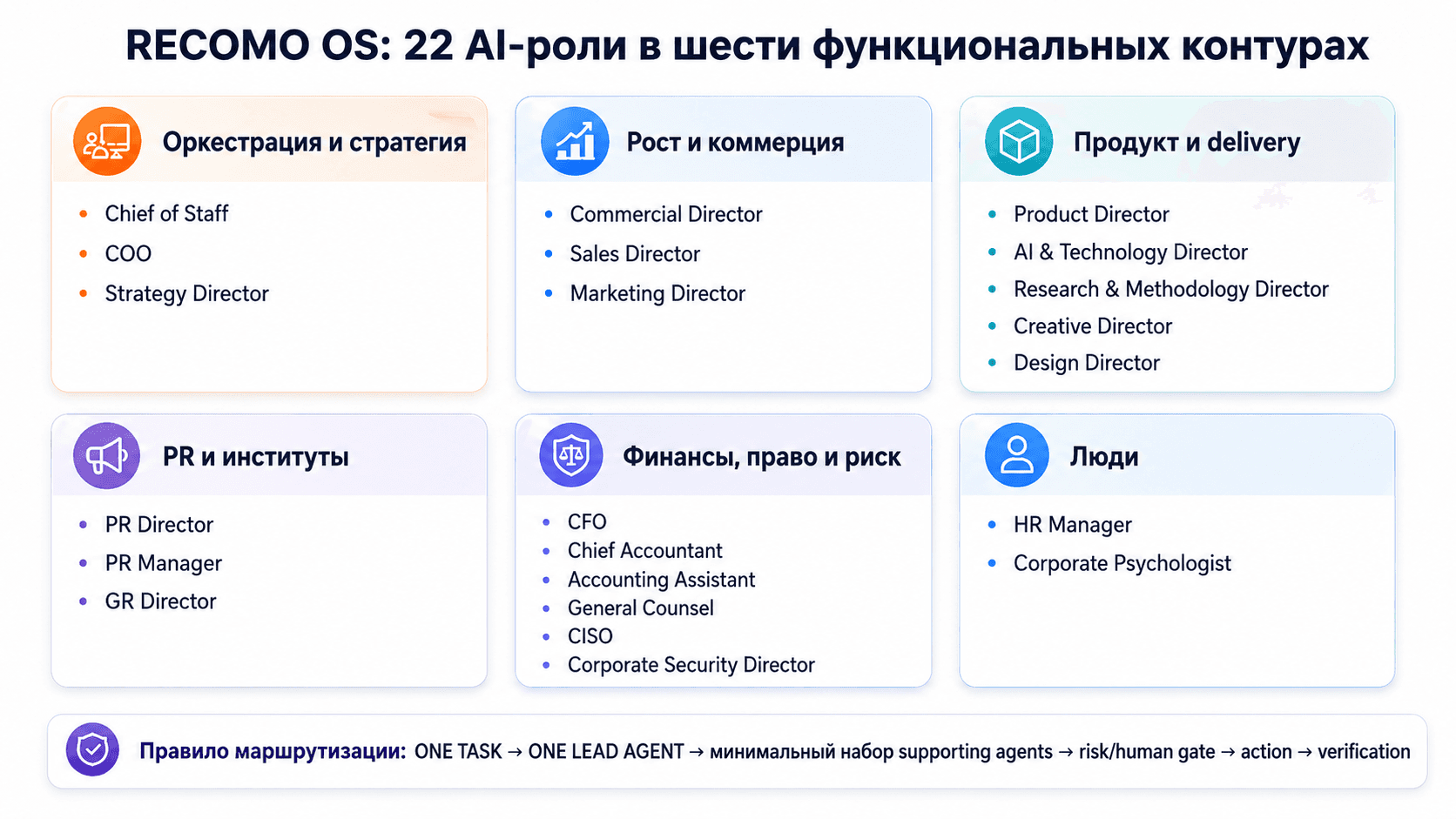
The 22 RECOMO AI Roles: Who Owns What
Orchestration & Strategy
Chief of Staff — Task routing, priorities, deadlines, and Founder Briefs.
COO — Translating decisions into workflows, SOPs, SLAs, and execution tracking.
Strategy Director — Strategic scenarios, prioritization, roadmaps, and stop/go decisions.
Growth & Commercial
Commercial Director — Monetization, packaging, commercial architecture, margins, and deal structures.
Sales Director — Lead qualification, pipeline management, follow-ups, and conversion to deals.
Marketing Director — Positioning, market demand, campaigns, and demand generation.
Product & Delivery
Product Director — Problem-solution fit, scope, roadmap, MVP, and product value delivery.
AI & Technology Director — AI architecture, agents, integrations, tooling, observability, and rollback protocols.
Research & Methodology Director — Research, evidence gathering, methodology, and reproducibility of insights.
Creative Director — Creative concepts, hooks, narratives, and story arcs.
Design Director — Visual systems, collateral, interfaces, presentations, and design QA.
PR & Institutional Affairs
PR Director — PR strategy, media relations, public positioning, and crisis communications.
PR Manager — Media lists, pitching, materials preparation, deadlines, and follow-ups.
GR Director — Government and institutional relations, and stakeholder management.
Finance, Legal & Risk
CFO — Cash flow, unit economics, budgeting, margins, and financial modeling.
Chief Accountant — Accounting, source documentation, compliance, and period-end close.
Accounting Assistant — Document collection, OCR recognition, classification, and reconciliation.
General Counsel — Contracts, IP, personal data, and legal liabilities.
CISO — Access control, data classification, least privilege enforcement, secrets management, and security controls.
Corporate Security Director — Counterparty, fraud, operational, and reputational risk management.
People
HR Manager — Human staffing, hiring, onboarding, performance reviews, and Human + AI team structure.
Corporate Psychologist — Workload management, conflict resolution, change management, and team resilience.
The Real Asset: Not the Agent List, but the Decision Engine
Anyone can draft a list of 20, 50, or 100 agents in an evening.
An operating system emerges only when the organization can answer:
What happened? Who owns the task? Which facts are verified? What options exist? Which risks need review? Can this execute autonomously? Where must a human step in? How do we verify the outcome?
Within RECOMO, this workflow follows a clear pipeline:
Capture → Route → Evidence → Options → Cross-check → Gate → Execute → Verify.
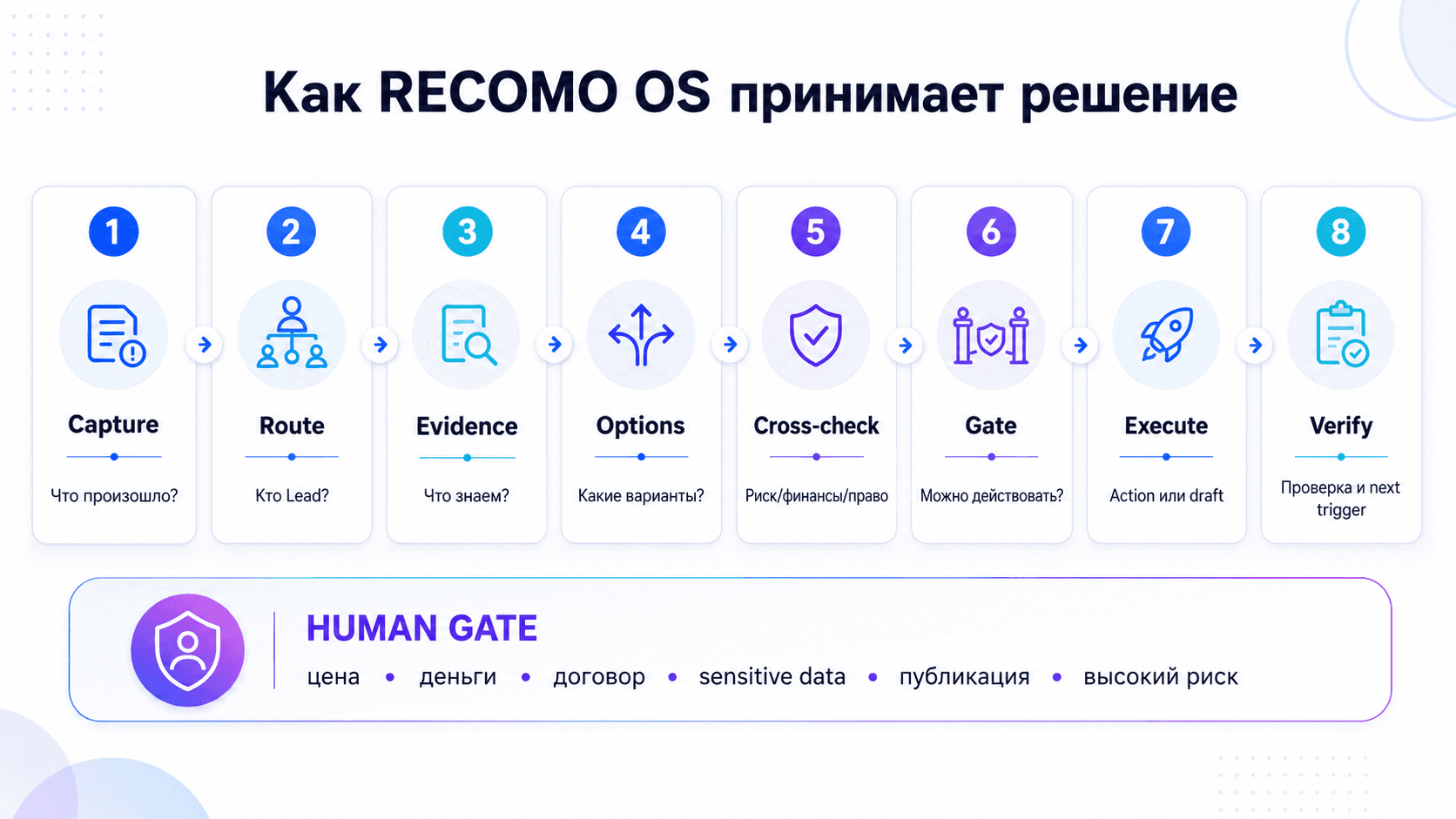
Where AI Autonomy Ends
Pricing and Commercial Terms
AI can compile benchmarks, calculate scenarios, and recommend terms.
However, setting new pricing, discounts, revenue-share models, equity, or non-standard payment terms requires human approval.
Capital Allocation
The system can analyze cash flow, audit documents, and draft recommendations.
Irreversible capital movements remain strictly human-controlled.
Legal Obligations
AI can run initial contract reviews and propose redlines.
It must never independently execute agreements or assume material legal liabilities.
Media and Public Statements
Metrics, client case studies, critical assessments, and material claims require an empirical evidence base and a formal publication/reputation review gate.
Security
Guided by least privilege: a digital role accesses only the data and permissions required to perform its specific function.
Founder External Commitments
Open calendar space does not mean automatic consent for speaking engagements, travel, or commercial commitments.
Certain decisions remain human not because AI lacks capability, but because accountability cannot be automated.
Why "100 Agents" Is a Poor KPI
Agent headcount works well as a PR metric for scale.
For business operations, it provides little value.
A company can deploy 100 AI roles and generate zero operational impact.
Conversely, implementing three digital roles can eliminate hundreds of hours of manual work.
Therefore, a Digital Workforce must be measured by unit economics and process efficiency, not by the number of personas on an org chart.
We prioritize five key metric groups:
cycle time;
cost per task;
error and rework rate;
share of manual labor;
business outcome.
Only after establishing baseline and post-implementation data can an organization credibly report cost savings, productivity gains, or team impact. We apply this exact evidence-based framework across our client-facing Digital Workforce practice.
Digital Workforce / Digital Back Office: RECOMO’s New Product Practice
Our internal RECOMO OS naturally evolved into a dedicated client offering:
Digital Workforce / Digital Back Office.
Starting such an initiative by asking "how many AI agents do you need?" is the wrong approach.
We start with core business operations.
1. Discovery
Business objectives, workflows, operational volume, cycle times, costs, failure rates, data readiness, and process ownership.
2. Process Mapping
Identifying where high-cost repetitive work actually occurs, and where adding AI would only introduce unnecessary complexity.
3. AI Opportunity Map
Ranking use cases by business value, feasibility, data availability, adoption readiness, and operational risk.
4. Bounded Pilot
Avoiding enterprise-wide automation all at once.
Selecting a single measurable process with clear baselines, bounded scope, human oversight, and defined stop/go criteria.
5. Orchestration
Configuring context handoffs between roles, access controls, tool integration, audit logging, and supervisory checks.
6. KPIs and Economics
Tracking time saved, cost per task, quality output, error rates, internal adoption, and realized business outcomes.
7. Scale / Iterate / Stop
Scaling only solutions that deliver verified ROI.
EUROPIIR as the First Flagship Implementation
We consider EUROPIIR the initial flagship implementation for RECOMO’s Digital Workforce practice.
Within an active client engagement, we are systematically designing digital back-office components and building an empirical process baseline.
This does not mean making premature claims today, such as:
"eight autonomous employees deployed";
"AI replaced N headcount";
"cost savings reached X percent."
Such metrics are published as verified case studies only after operational validation and client approval. This boundary is directly built into the project's current architecture.
Our focus is building a reproducible delivery framework:
Process → Role → Permissions → KPI → Human Gate → Outcome.
What This Means for Leadership
A digital back office does not replace management.
On the contrary, it quickly exposes weak management.
If a process lacks documentation, ownership is undefined, KPIs are absent, permissions are ambiguous, and decisions are scattered across chat channels, AI will simply help the organization automate its own chaos faster.
In the AI Workforce era, the critical capability is no longer prompt engineering.
It is process engineering + governance.
Leaders need clear answers to five essential questions:
Who owns the task?
Which data sources are authorized?
What actions can the AI take autonomously?
Where must the AI stop for approval?
What measurable metric defines success?
Three Key Takeaways
First. Enterprise AI is moving from "assistant mode" to core operational architecture.
MWS developing a digital back office of 100 AI employees is a prominent signal of this market transition.
Second. Competitive advantage will not belong to the company with the highest agent count.
It will belong to organizations with better-structured processes, clean data, robust routing, clear autonomy limits, human approval gates, and precise outcome tracking.
Third. RECOMO OS runs 22 specialized AI roles as an internal operating proving ground.
Our client-facing Digital Workforce practice applies this exact foundation to other enterprises:
Processes and unit economics first—AI agents second.
RECOMO's Operating Statement
RECOMO OS is an operating model where 22 specialized AI roles support leadership across strategy, sales, product, PR, research, finance, legal, security, and HR. External liabilities and irreversible decisions remain under human control.
About the Author
Sergey Semenov is the Founder and CEO of RECOMO.
RECOMO operates at the intersection of AI Visibility, AI Agents, and Digital Transformation, developing its Digital Workforce / Digital Back Office practice to design digital teams aligned with specific enterprise workflows.
Sources
MTS Web Services, May 19, 2026. "MTS Web Services pilots virtual employees": coverage across 10+ business functions, orchestration frameworks, and reported acceleration of specific processes by up to 40%.
PPC.world, August 2026. Coverage on MWS developing a digital back office of 100 AI agents.
Sostav.ru, August 17, 2026. Sergey Semenov: Published overview of RECOMO's Human + AI framework and 22-role digital architecture.
RECOMO OS. Canonical architecture of the 22 specialized AI roles.
Share
Read also
Not 100 Agents, but a New Business Architecture: How Companies Are Transitioning to a Digital Back Office
MWS is building a digital back office of 100 AI employees. RECOMO is creating its own operating model with 22 specialized AI roles. We break down why the future of enterprise AI is not about the number of agents, but about processes, orchestration, human gates, and measurable results.
Executive AI Assistant: How to Manage Email, Calendar, and Business via Voice
An AI assistant sorts emails, manages calendars, prepares documents, and triggers workflows via voice commands. We explore how it works and where human oversight remains essential.