← Back to blog
AI Visibility
July 16, 2026
Updated July 16, 2026
25 minutes
Author: Sergei Semjonov, Founder of RECOMO

AI Insights
Key takeaway
We compared 13 popular AI Visibility tools, including Profound, Peec AI, Otterly, Semrush AI Toolkit, Similarweb, and more. Explore their capabilities, limitations, and how to measure brand presence across ChatGPT, Gemini, Claude, and Perplexity.
Read time
25 minutes
Category
AI Visibility
Publication date
July 16, 2026
Last updated
July 16, 2026
SEO No Longer Answers the Core Question
Just a few years ago, marketers competed for the top spot on Google.
The higher a website ranked in search results, the more traffic it received—driving more leads and sales.
Today, this dynamic is shifting rapidly.
An increasing number of users bypass search results entirely, posing their questions directly to artificial intelligence instead.
For example:
Which CRM is best for a manufacturing company?
What analytics platforms do major e-commerce brands use?
Which AI SDR should I choose for B2B?
Instead of ten blue links, the user receives a single synthesized answer with a handful of recommendations.
This shortlist of companies is increasingly becoming the very first touchpoint between a brand and a prospective customer.
While marketers once fought for rank on search engine results pages, the battle has shifted to earning a spot inside responses from ChatGPT, Gemini, Claude, and Perplexity.
This represents an entirely new challenge.
What Is AI Visibility?

AI Visibility measures how frequently generative AI models recommend your brand, product, or website to users.
While traditional SEO answers:
Where does my website rank?
AI Visibility answers a fundamentally different question:
How often does artificial intelligence recommend my company?
At first glance, they might seem identical.
In practice, they are not.
For instance, a company might rank #1 on Google for small business CRM yet barely be mentioned in ChatGPT responses.
Conversely, some brands receive frequent LLM recommendations despite having significantly lower traditional search rankings than their competitors.
This occurs because generative models synthesize answers using more complex mechanisms. They evaluate a broad array of signals: source authority, topical depth, content structure, third-party brand mentions, documentation quality, and numerous other factors.
Consequently, AI Visibility is becoming an independent marketing metric rather than a mere extension of SEO.
Why SEO Is No Longer Enough
SEO hasn't disappeared.
However, the way users discover information has fundamentally changed.
Until recently, the customer journey was linear:
Today, it increasingly looks like this:
In this flow, the search engine results page may not be visited at all.
AI presents a shortlist of solutions instantly, highlights key differentiators, and guides the user toward a decision.
This makes tracking website rankings alone insufficient for modern businesses.
Now, teams need to know:
whether ChatGPT recommends your brand;
how often your company appears in Gemini responses;
whether Claude cites your website assets;
which competitors dominate Perplexity recommendations;
which specific pages serve as reference sources for generative models.
Without these insights, accurately assessing your brand’s actual market presence in the new search ecosystem is impossible.
The Emergence of the AI Visibility Market
As marketers faced this shift, they quickly discovered that standard analytics tools could not answer their most critical questions.
Google Search Console tracks search queries and clicks.
Ahrefs and Semrush track keyword rankings and backlinks.
Web analytics platforms measure site visits and conversions.
Yet none of these tools answer:
How often does ChatGPT recommend my company?
This gap led to the rise of a new software category over the past two years: AI Visibility Platforms.
These platforms programmatically monitor hundreds or thousands of prompts across major generative models, log outputs, track brand mentions, benchmark against competitors, and measure visibility trends over time.
For many marketing teams, AI Visibility is quickly becoming as essential a KPI as organic traffic and keyword rankings were a decade ago.
What You Will Learn in This Guide
This review evaluates 13 leading AI Visibility monitoring platforms, comparing their core capabilities.
You will learn:
which AI models each platform supports;
which metrics reliably reflect brand visibility;
the functional differences between monitoring tools and optimization platforms;
which tools fit SMBs versus enterprise organizations;
key criteria to evaluate when selecting a solution for your business.
Finally, we will examine why monitoring alone is no longer sufficient and how AI Visibility is evolving from simple reporting into a comprehensive digital marketing discipline.
How ChatGPT, Gemini, Claude, and Perplexity Select Brands

At first glance, generative models might seem to operate identically.
A user submits a query:
Which CRM should I choose for a mid-market company?
And receives a list of platforms.
However, asking the exact same question across ChatGPT, Gemini, Claude, and Perplexity yields noticeably different results.
Some models prioritize HubSpot and Salesforce.
Others surface Pipedrive, Zoho, or niche regional providers.
In many cases, the overlap between recommendations is only 40% to 60%.
This raises an obvious question:
Why do different AI models recommend different companies?
The reality is that modern LLMs do not reference a single universal "best companies" directory. Each model generates responses based on its unique architecture, training corpora, retrieval methods, and synthesis algorithms.
Core Signals Behind AI Recommendations
Despite architectural differences, most models rely on a consistent set of underlying signals.
1. Source Authority
When industry publications, market research platforms, independent reviews, and subject-matter experts consistently cover a company, its likelihood of appearing in AI responses increases significantly.
Coverage in trade media, original research, technical documentation, and expert analyses help the model understand what the company offers and in which specific contexts to recommend it.
This is why strong PR and content marketing now directly influence AI Visibility alongside traditional SEO.
2. Content Depth
Generative models favor sources that answer user inquiries thoroughly.
If an article offers only high-level commentary while a competitor provides an exhaustive guide complete with examples, comparison tables, and FAQs, the latter is far more likely to be used as a grounding source.
For LLMs, comprehensive topical coverage matters far more than simple keyword placement.
3. Page Structure
Modern models process structured, cleanly formatted content more effectively.
Key structural elements include:
logical H2 and H3 hierarchies;
bulleted and numbered lists;
structured tables;
clear definitions;
frequently asked questions (FAQs);
step-by-step workflows.
These pages are easier for models to parse and synthesize, making them primary targets for grounding generative answers.
4. Brand Reputation
Consistent third-party mentions across authoritative domains combined with positive sentiment increase recommendation frequency.
While models do not use a single centralized "trust score," aggregated contextual signals help the system determine which brands represent safe, reliable choices within a given vertical.
5. Query Context
Critically, generative models match recommendations to the specific prompt context rather than returning a static list of market leaders.
For example, distinct prompts such as:
best CRM for small business;
CRM for manufacturing;
CRM for outbound sales teams;
European CRM provider;
can produce entirely distinct recommendations.
Because of this nuance, AI Visibility cannot be evaluated using just one or two test prompts. Gaining an accurate picture requires analyzing dozens or hundreds of distinct search scenarios.
Why Model Outputs Vary
Each generative model is developed independently.
They vary across several dimensions:
training datasets and corpora;
live retrieval and search mechanisms;
web content processing and extraction methods;
knowledge cutoff dates and update frequency;
source attribution and citation policies;
synthesis and output formatting guidelines.
For example, Perplexity relies heavily on real-time web retrieval and consistently cites source URLs.
Google AI Overviews is deeply integrated with Google's search index and ranking signals.
Claude emphasizes structured, detailed analytical explanations.
ChatGPT alternates between its pre-trained knowledge base and live web browsing depending on configuration and user intent.
As a result, a brand may see high visibility in one model while remaining virtually absent from another.
Why Manual Testing Fails
Many companies approach AI Visibility with ad-hoc manual testing.
A marketer runs two or three prompts in ChatGPT and concludes:
"We are being recommended."
Or conversely:
"We aren't showing up anywhere."
This approach is almost always misleading.
First, a single prompt does not reflect real-world user intent. Buyers phrase identical needs in dozens of different ways.
Second, model outputs are dynamic. Model updates, retraining, and newly indexed web content can alter the recommended vendor list overnight.
Third, outputs vary based on language, geographic location, phrasing variations, and selected model versions.
To measure AI Visibility reliably, organizations must track:
dozens or hundreds of prompt variations;
multiple generative models simultaneously;
target languages and target regions;
performance shifts over time.
This operational scale is precisely what dedicated AI Visibility platforms deliver.
What AI Visibility Platforms Measure
Because spot-checks fail to provide reliable insights, modern platforms continuously track and analyze large datasets across target prompts.
They answer strategic questions:
How frequently does ChatGPT recommend our brand?
Which competitors appear alongside us?
In which topics or categories do we hold dominant visibility?
Which pages are most frequently cited as grounding sources?
How did visibility change after launching new content assets?
These insights provide marketing leaders with a reliable, continuous view of brand presence across generative search.
Below, we break down the specific metrics AI Visibility platforms track and why they represent a new standard for evaluating content performance.
Marketers evaluating what to track and why will find this breakdown essential for building a data-driven GEO strategy.
Core Metrics Tracked by AI Visibility Platforms

When organizations first evaluate AI Visibility, they often attempt to apply standard SEO metrics.
These typically include:
keyword rankings;
total indexed keywords;
organic search traffic;
click-through rates (CTR);
total clicks.
However, generative search operates under an entirely different paradigm.
Users do not browse a page of search results; they read a synthesized response prepared by the model.
Consequently, traditional SEO metrics are being supplemented by new data points designed to evaluate brand prominence within LLMs.
Here are the core metrics you should monitor.
1. AI Share of Voice
This is the primary benchmark in AI Visibility.
It measures how often an AI model recommends your brand relative to your competitors across a target set of queries.
For example, across an evaluation run of 500 prompts:
The results might show:
Company | Total Recommendations |
|---|---|
Company A | 198 |
Company B | 146 |
Company C | 97 |
Company D | 59 |
In this scenario, Company A holds the highest AI Share of Voice.
It functions much like market share, measured not in revenue, but in conversational LLM recommendations.
Where marketers once focused on search Share of Voice, many are now adopting AI Share of Voice as a key performance indicator.
2. Brand Mentions
Another fundamental metric is the total volume of brand mentions.
It answers a straightforward question:
How many times did the generative model name our company?
If ChatGPT recommends your company in 38 out of 100 tested prompts,
your Brand Mention rate is 38%.
However, high mention volume does not automatically indicate market leadership.
A brand might be mentioned frequently, but consistently placed second or third on the recommended list.
For this reason, Brand Mentions should always be evaluated alongside AI Share of Voice.
3. Prompt Coverage
This is one of the most actionable yet overlooked metrics.
It identifies which specific search intents and query clusters trigger your brand’s recommendation.
Take a B2B SaaS company selling CRM software.
The brand might perform exceptionally well for:
small business CRM
Yet remain completely absent from queries like:
CRM for manufacturing;
CRM for outbound sales teams;
enterprise B2B CRM;
CRM for supply chain and logistics.
Prompt Coverage quickly surfaces these strategic gaps.
To support this, leading platforms allow teams to segment prompts by topic, product line, or buyer journey stage.
4. Citation Sources
In traditional SEO, tracking domain positions was sufficient.
Today, it is equally important to know:
Which web assets is the model citing to synthesize its answer?
Certain platforms (such as Perplexity) explicitly link to cited sources.
Others include citations dynamically based on user prompts.
AI Visibility platforms analyze these references to identify:
which domains are cited most frequently;
which specific URLs serve as grounding sources;
which third-party publications power competitor mentions;
which high-authority industry platforms your brand is missing from.
This data informs both content optimization and targeted digital PR campaigns.
5. Competitor Analysis
Most platforms include side-by-side competitive benchmarking.
For example:
Prompt | Your Brand | Competitor A | Competitor B |
|---|---|---|---|
CRM | ❌ | ✅ | ✅ |
B2B CRM | ✅ | ✅ | ❌ |
Regional CRM Provider | ✅ | ❌ | ❌ |
This matrix highlights where your brand already holds authoritative mindshare and where competitors currently dominate.
6. Visibility Trends
AI Visibility is never static.
Generative model outputs fluctuate continuously.
These fluctuations stem from several factors:
model retraining and weight adjustments;
indexing of new web sources;
publication of fresh content assets;
changes to site architecture;
competitor marketing initiatives.
Modern platforms track these changes over time via historical trend graphs.
Analyzing historical trends helps teams verify whether recent website updates and content publications are delivering tangible results.
7. AI Sentiment
Advanced platforms evaluate more than binary mentions; they analyze the contextual sentiment of the recommendation.
For example:
"Company X is an established enterprise market leader."
versus
"Company X is suitable for small teams, but lacks key enterprise features."
Both responses constitute a brand mention,
yet they deliver completely different commercial outcomes.
AI Sentiment tracking helps brands monitor how LLMs perceive and position their product features.
8. Entity Coverage
Entity coverage is an increasingly important semantic metric.
It assesses how comprehensively your digital footprint covers the core entities, concepts, and attributes associated with your product category.
For a CRM platform, key entities include:
sales pipeline automation;
lead routing;
funnel management;
ERP integrations;
telephony integration;
email marketing workflows;
revenue intelligence.
The more clearly your site defines and connects these entities, the more readily generative models will cite your content as an authoritative source.
Why Tracking a Single Metric Fails
Teams occasionally fall into a common trap:
"Our brand appears in 25% of queries, so our visibility is solid."
In practice, headline numbers can obscure underlying risks.
Consider two hypothetical companies:
Metric | Company A | Company B |
|---|---|---|
AI Share of Voice | 25% | 25% |
Prompt Coverage | 18% | 72% |
Citation Sources | 6 | 41 |
Visibility Trend | Declining | Growing |
While both share an identical 25% AI Share of Voice,
their underlying market trajectories are entirely different.
This is why comprehensive AI Visibility management requires monitoring a balanced scorecard rather than relying on an isolated metric.
What Marketers Should Prioritize
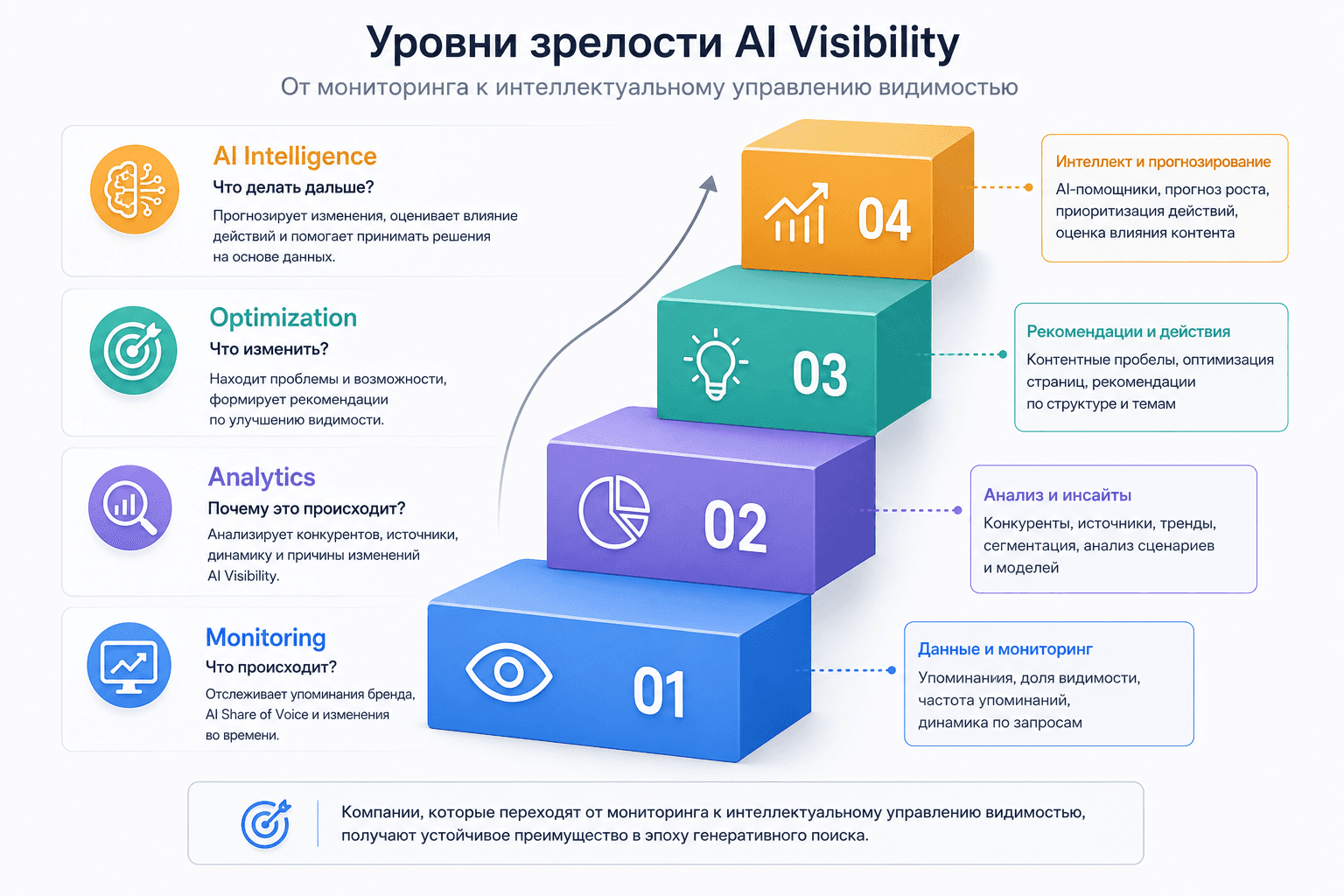
In day-to-day operations, most marketing teams focus on five essential metrics:
AI Share of Voice — overall recommendation frequency across target models.
Prompt Coverage — breadth of search queries where the brand is visible.
Competitor Analysis — which alternative solutions are recommended in your place.
Citation Sources — which third-party domains ground AI responses.
Visibility Trends — measurable impact following content launches and site updates.
Tracking these core indicators provides both an accurate benchmark of current performance and clear validation of ongoing optimization work.
Moving Forward
With a clear understanding of what AI Visibility platforms measure, we can now compare the top solutions available on the market.
In the next section, we evaluate 13 AI Visibility monitoring tools, detailing their platform features, supported models, operational strengths, and limitations to help you find the right fit for your team.
Comparing 13 AI Visibility Monitoring Platforms
Over the last two years, the AI Visibility software space has expanded dramatically. While early 2024 saw only a handful of specialized utilities, dozens of vendors now offer dedicated generative search monitoring tools.
However, their feature sets address very different business needs.
Some platforms focus purely on logging brand mentions across ChatGPT and Perplexity.
Others emphasize competitor benchmarking and reverse-engineering citation sources.
A third group goes a step further by identifying actionable on-page optimizations to increase recommendation frequency within LLMs.
To maintain an objective comparison, we evaluated each platform against standard operational criteria:
supported AI models;
mention tracking capabilities;
competitive benchmarking;
citation source identification;
actionable optimization guidance;
dashboard usability;
target customer segment.
Platform Comparison Overview
Platform | ChatGPT | Gemini | Claude | Perplexity | Competitor Benchmarking | Citation Analysis | GEO Guidance | Target Segment |
|---|---|---|---|---|---|---|---|---|
Profound | ✅ | ✅ | ✅ | ✅ | ✅ | ✅ | ❌ | Enterprise |
Peec AI | ✅ | ✅ | ✅ | ✅ | ✅ | ✅ | ❌ | SMB |
Otterly AI | ✅ | ✅ | — | ✅ | Partial | Partial | ❌ | Small Business |
Gumshoe | ✅ | ✅ | ✅ | ✅ | ✅ | ✅ | Partial | B2B |
AthenaHQ | ✅ | ✅ | ✅ | ✅ | ✅ | ✅ | Partial | Enterprise |
Goodie AI | ✅ | ✅ | Partial | ✅ | Partial | Partial | ❌ | Enterprise |
Semrush AI Toolkit | ✅ | ✅ | — | ✅ | ✅ | ✅ | Partial | SEO Teams |
Similarweb AI | ✅ | ✅ | — | ✅ | ✅ | Partial | ❌ | Enterprise |
Hall | Partial | — | — | — | ❌ | Crawl Analysis | ❌ | Technical Teams |
RankPrompt | ✅ | ✅ | ✅ | ✅ | ✅ | ✅ | ✅ | Agencies |
Searchable | ✅ | ✅ | — | ✅ | Partial | ✅ | Partial | Content Teams |
Promptwatch | ✅ | ✅ | ✅ | ✅ | ✅ | ✅ | ✅ | Growth Teams |
Recomo | ✅ | ✅ | ✅ | ✅ | ✅ | ✅ | ✅ | Marketing & SEO |
1. Profound
Best for: Enterprise organizations.
Profound is an established brand in enterprise AI Visibility monitoring. The platform is designed for large global brands requiring structured visibility tracking across multiple generative models.
Core Features
cross-model tracking for ChatGPT, Gemini, Claude, and Perplexity;
AI Share of Voice calculations;
competitive benchmarking;
historical trend reporting;
enterprise data export options.
Pros
✅ Comprehensive analytical capabilities;
✅ Enterprise-grade reporting dashboards;
✅ Robust multi-model support.
Cons
❌ High entry pricing;
❌ Excessive operational complexity for smaller teams.
Rating: ★★★★★
2. Peec AI
Best for: SaaS and mid-market companies.
Peec AI emphasizes rapid onboarding and UI simplicity. Its interface is intuitive, enabling teams to access essential visibility reports without lengthy configuration.
Core Features
multi-LLM tracking;
AI Share of Voice measurement;
competitor comparisons;
daily automated query checks.
Pros
✅ Clean, accessible interface;
✅ Balanced cost-to-feature ratio.
Cons
❌ Fewer granular analytics compared to enterprise suites.
Rating: ★★★★☆
3. Otterly AI
Best for: Small businesses.
Otterly is an accessible entry point for organizations exploring AI Visibility for the first time.
For teams looking to verify basic brand presence inside ChatGPT, Otterly provides an efficient, low-barrier starting point.
Pros
competitive pricing;
straightforward setup;
rapid deployment.
Cons
basic feature set;
limited deep-dive analytics.
Rating: ★★★★☆
4. Gumshoe
Gumshoe distinguishes itself with persona-based recommendation analysis.
Teams can evaluate prompts across distinct buyer personas, such as:
C-level executives;
marketing managers;
sales leadership;
technical specialists.
This methodology shows how LLM recommendations adjust according to persona framing.
Rating: ★★★★☆
5. AthenaHQ
AthenaHQ pairs visibility tracking with content gap identification.
Alongside brand mention tracking, the platform highlights editorial topics worth expanding to improve generative search inclusion.
Target Audience: Enterprise and scaling marketing teams.
Rating: ★★★★☆
6. Goodie AI
Goodie AI specializes in conversational commerce and AI shopping environments.
This focus makes the tool valuable for consumer retail and e-commerce brands.
The product is primarily geared toward enterprise-scale operations.
Rating: ★★★☆☆
7. Semrush AI Toolkit
Semrush is incorporating AI Visibility capabilities directly into its broader SEO platform.
For teams already using Semrush for search optimization, this integration provides an efficient transition path.
Strengths
unified SEO and AI search workflows;
familiar user interface;
integrated competitive intelligence.
Rating: ★★★★☆
8. Similarweb AI
Similarweb leverages its global digital intelligence infrastructure to track AI search dynamics.
The platform suits organizations focused on macro-level market share and competitive industry benchmarking.
Rating: ★★★★☆
9. Hall
Hall uses a different architectural focus than most monitoring tools.
Rather than focusing strictly on output recommendations, it monitors AI crawler activity and audits how LLM bots interact with site infrastructure.
This data is primarily useful for technical SEO and engineering teams.
Rating: ★★★☆☆
10. RankPrompt
RankPrompt combines visibility monitoring with actionable content optimization workflows.
It is well-suited for SEO specialists and digital agencies aiming to improve, rather than just observe, LLM visibility metrics.
Rating: ★★★★☆
11. Searchable
Searchable specializes in mapping and analyzing the source citations behind generative model outputs.
This makes it a practical asset for content marketing teams and editorial publishers investing heavily in thought leadership.
Rating: ★★★★☆
12. Promptwatch
Promptwatch covers several functional areas within a single platform:
visibility tracking;
competitive analytics;
optimization recommendations;
prompt discovery and testing.
It represents one of the more versatile solutions in this review.
Rating: ★★★★☆
13. Recomo
Most tools on the market address the observational question:
"What is happening?"
They provide metrics such as:
total ChatGPT brand mentions;
top recommended competitors;
models surfacing the company.
However, once marketers review their dashboards, they inevitably hit the strategic bottleneck:
"What specific actions should we take next?"
This is where AI Visibility moves from reporting into proactive optimization.
Recomo helps teams not only monitor brand visibility, but actively optimize it.
The platform analyzes:
site architecture and semantic hierarchy;
depth of topical coverage;
entity definitions and relational structure;
underlying content gaps;
specific root causes behind low AI Visibility.
This structured analysis bridges the gap between analytics dashboards and editorial execution.
This is why Recomo functions not just as a tracking tool, but as a dedicated AI Visibility Optimization platform.
Market Evolution: A Generational Shift

Evaluating these platforms reveals a clear developmental pattern across the industry.
The overall market is transitioning across three distinct product generations:
Generation 1
Platforms answer:
What is happening?
This generation focuses purely on observational monitoring and mention logging.
Generation 2
Platforms answer:
Why is it happening?
This generation analyzes competitor performance, citation sources, and historical trends.
Generation 3
Platforms answer:
What specific changes will improve performance?
This segment represents the primary growth vector in modern Generative Engine Optimization (GEO).
Tools in this category help teams systematically increase their brand presence across generative answers rather than simply monitoring current status.
How to Select an AI Visibility Platform: Step-by-Step Guide
At first glance, many AI Visibility tools appear to offer overlapping functionality.
In reality, their capabilities vary significantly based on company scale and use case.
Some products serve SMBs monitoring a handful of queries.
Others are built for enterprise organizations analyzing thousands of queries across multiple international markets.
A third group focuses on identifying growth opportunities to improve visibility directly.
To choose the right platform, work through the following evaluation steps.
Step 1. Define Your Primary Objective
This is the most critical decision in the evaluation process.
Many teams review software without clearly defining what they need the tool to solve.
In practice, requirements generally fall into four core tiers:
Objective | Required Tooling |
|---|---|
Verify if AI recommends our brand | Basic Monitoring |
Benchmark against competitors | Competitive Intelligence |
Identify causes of low visibility | AI Analytics |
Increase recommendation frequency | AI Visibility Optimization |
If your immediate requirement is simply answering:
"Does ChatGPT ever mention our brand?"
a basic monitoring service is entirely sufficient.
However, if the strategic goal is to increase brand presence in LLM answers, you need a platform that delivers actionable optimization guidance, not just charts.
Step 2. Identify Target AI Models
You don't necessarily need to monitor every generative model on the market.
Prioritize according to where your audience searches:
Standard B2B Deployments Typically Prioritize
ChatGPT
Gemini
Claude
Perplexity
E-Commerce and Retail Teams Should Add
Google AI Overviews
Microsoft Copilot
AI Shopping features
Global and Multi-Region Brands Must Ensure Support For
Key requirements include:
multi-language tracking;
regional geo-targeting;
localized engine variations.
As your geographic footprint expands, reliable regional localization becomes critical.
Step 3. Estimate Required Prompt Volume
Prompt capacity limits are often underestimated during procurement.
Many entry-level plans advertise packages such as:
100 tracked prompts
Here is what that looks like in practice:
Take a B2B SaaS company.
They plan to monitor five core topics:
CRM
small business CRM
outbound sales CRM
manufacturing CRM
regional CRM provider
While that seems like only five queries,
each topic involves dozens of realistic phrasing variations.
Consequently, an effective tracking project quickly expands into hundreds of prompts.
Operational Example
Consider a company tracking:
50 core prompts
×
4 AI models
×
2 languages
×
3 target regions
This equates to:
1,200 individual AI checks per monitoring run.
When selecting a vendor, look closely at how the platform structures its limits around prompts, projects, geographic locations, and query frequency.
Step 4. Match Platform Data to Team Roles
Different stakeholders need different insights from AI Visibility data.
Metric | Primary Stakeholder |
|---|---|
AI Share of Voice | CMO / Marketing Leadership |
Brand Mentions | Communications / PR Teams |
Prompt Coverage | SEO Strategists |
Citation Sources | Content Marketing Leads |
Visibility Trends | Growth Product Managers |
AI Sentiment | Brand Marketing Leads |
Prioritize platforms that serve your team's specific day-to-day operational needs to avoid paying for unused features.
Step 5. Monitoring vs. Optimization Capabilities
This is the central strategic distinction in the AI Visibility market today.
Most tools stop once they render a performance chart.
For example:
However, marketing leaders inevitably need to answer:
Why did the metric drop?
And more importantly:
What specific actions are required to improve it?
This highlights the clear difference between product approaches:
Monitoring
Answers:
What happened?
Analytics
Answers:
Why did it happen?
Optimization
Answers:
What needs to change?
Optimization-first platforms represent the future of Generative Engine Optimization.
Selecting the Right Tool for Your Organization
Startups
Teams initiating their first AI Visibility initiatives should prioritize simple tools with accessible pricing.
Recommended options:
Otterly AI;
Peec AI.
The primary goal is establishing a baseline: how often is the brand cited across prominent models?
Mid-Market Companies
Teams running mature SEO and content marketing operations usually outgrow basic monitoring quickly.
Recommended options:
Promptwatch;
AthenaHQ;
Gumshoe;
Searchable.
These tools offer deeper root-cause analysis behind visibility fluctuations, uncovering new growth opportunities.
Enterprise
Large organizations require broad infrastructure support:
global multi-country tracking;
multi-language support;
large prompt capacities;
multi-user access and collaboration controls;
robust API access;
enterprise data governance and reporting.
Leading enterprise options include:
Profound;
Similarweb AI;
Semrush AI Toolkit.
When the Goal Is Actively Increasing AI Visibility
This requires a focused toolset.
If your goal is to move beyond passive observation and systematically scale your brand's presence across LLMs, choose platforms that help you:
identify topical and content gaps;
audit site architecture against retrieval models;
map missing semantic entities;
analyze why competitors are cited over your assets;
generate clear editorial action plans.
This capability transforms AI Visibility from passive reporting into an active growth channel.
Vendor Evaluation Checklist
Before committing to a subscription, review these key questions with prospective vendors:
✅ Which specific generative models are tracked?
✅ Is non-English / target-language query testing supported?
✅ Can query performance be tracked across multiple target countries?
✅ How does the vendor count usage against prompt and project limits?
✅ Does the platform maintain complete historical trend data?
✅ Is competitor benchmarking included?
✅ Does the system display exact citation URLs?
✅ Does the platform provide concrete on-page optimization recommendations?
If a tool cannot meet your core operational requirements across these areas, consider exploring alternative options.
Key Takeaways
The right AI Visibility tool depends less on budget and more on your team's operational maturity:
If you are just getting started, lightweight monitoring is often sufficient.
If you run active SEO and content programs, you need diagnostic analytics to understand root causes.
If AI search is becoming a core acquisition channel, you need an optimization platform that directly drives improved visibility.
Because of this shift, the industry is moving rapidly from descriptive reporting toward actionable AI Visibility Optimization.
Why Monitoring AI Visibility Is No Longer Enough
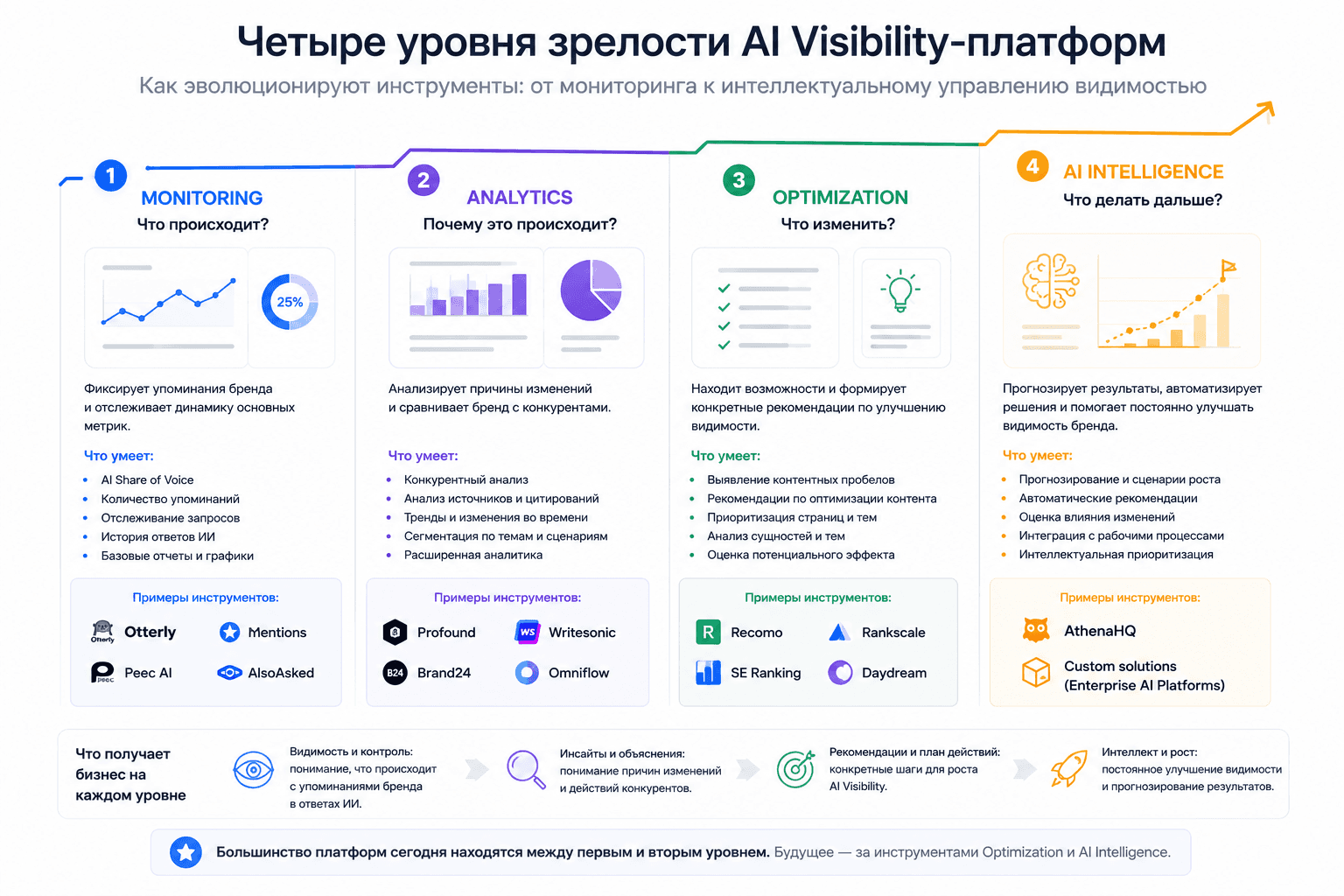
The AI Visibility landscape is tracing the historical evolution of traditional SEO.
Fifteen years ago, early SEO software did little more than track keyword rankings.
Over time, link analysis tools emerged.
Technical site auditing followed.
Finally, data-driven content optimization features became standard.
Today, no marketing team buys an SEO platform solely to check keyword rankings.
Teams expect software that shows:
why an asset is losing organic traffic;
which specific URLs need updates;
which missing topics need to be covered;
what strategic steps should be taken next.
AI Visibility is moving through this exact same operational evolution.
The Limitation of Monitoring-Only Tools
Consider a typical dashboard report:
The visualization is clear,
yet it leaves marketers without actionable answers to critical questions:
Why did visibility decline?
What changed in model outputs or sources?
Which specific pages contributed to the drop?
What content did competitors launch?
What actions will reverse this trend?
Most baseline tracking utilities cannot answer these questions.
The Workflow Bottleneck
This leads to a predictable bottleneck across marketing teams:
A team member logs into the dashboard,
and observes:
AI Share of Voice dropped by 8%.
The obvious next question is:
What do we do about it?
At this point, monitoring-only tools reach their functional limit.
They identify the problem,
but provide no mechanism to resolve it.
What Marketers Actually Need
In practice, marketing teams require direct answers to operational questions:
For example:
Why does ChatGPT recommend our competitor?
Why does Perplexity ground its answer in a third-party article instead of ours?
Which URLs are cited most frequently in our niche?
Which essential topics are absent from our website?
Which semantic entities require clearer definitions?
What content asset should we write next to drive impact?
Which specific on-page updates will yield the highest return?
This requires a more sophisticated analytical approach.
Monitoring Is Only the First Step
We can map AI Visibility maturity across four clear functional tiers:
Maturity Tier | Operational Question |
|---|---|
Monitoring | What is happening? |
Analytics | Why is it happening? |
Optimization | What should we change? |
Execution | How do we deploy the updates? |
Today, most available platforms operate strictly within the first two tiers.
The industry is steadily moving toward the next stages.
Why AI Visibility Cannot Be Solved with Shortcuts
Marketers occasionally seek a "magic bullet" for ranking in ChatGPT.
The reality is far more complex.
Generative models evaluate many interconnected signals simultaneously:
These include:
topical comprehensiveness;
structural clarity of content;
depth and accuracy of explanations;
domain and brand authority;
independent third-party brand citations;
author credibility and expertise;
citation frequency across web datasets;
semantic entity relationships;
freshness and relevance of information.
Improving AI Visibility requires continuous work on overall site structure and content quality, rather than simple tactical fixes.
How Teams Typically Adopt AI Visibility
Across marketing organizations, adoption typically follows a consistent path:
Stage 1: Ad-Hoc Testing
Marketers run manual queries inside ChatGPT to check for brand mentions.
Stage 2: Monitoring Adoption
The team subscribes to an AI Visibility tool to access automated tracking dashboards.
Stage 3: Trend Observation
Stakeholders regularly monitor performance trend lines.
Stage 4: Strategic Bottleneck
Leadership realizes that observing metrics does not organically improve them.
Stage 5: Optimization Focus
The team begins systematically diagnosing root causes.
This is the moment teams transition from monitoring
to active optimization.
The Rise of AI Visibility Optimization
The evolution of traditional SEO offers a clear blueprint:
New software categories emerge when current tools can no longer solve downstream problems.
Knowing keyword positions was once enough.
Then teams needed to understand what caused ranking shifts.
Next came automated tools that diagnosed technical errors directly.
AI Visibility is following this same progression.
It is no longer enough to know that ChatGPT omitted your brand from a recommendation.
Organizations need to know:
which specific topics require deeper coverage;
which critical pages are missing from their site;
which competitor resources LLMs prefer to cite;
why their domain is being bypassed in generative search results.
How RECOMO Fits into the Optimization Workflow
We treat AI Visibility as an ongoing optimization lifecycle rather than a static reporting dashboard.
This operational cycle consists of clear, repeatable stages:
RECOMO is built not just to report visibility metrics, but to help marketing teams pinpoint which practical content and structural changes will measurably improve brand presence across generative search.
There is no guaranteed formula for ranking inside ChatGPT, as frontier lab algorithms are proprietary and outputs can change over time. However, companies can systematically improve their inclusion rates by focusing on high-quality content, topical depth, source authority, and clean site structure—the core signals modern LLMs rely on to generate grounded responses.
AI Visibility as a Continuous Marketing Practice
Over the next several years, leading marketing teams will structure their GEO workflows around a clear cycle:
Measure baseline AI Visibility.
Diagnose drivers behind visibility changes.
Identify content and entity gaps.
Develop prioritized optimization plans.
Implement site and content updates.
Re-measure performance against the baseline.
This continuous workflow is becoming the standard for brands looking to maintain prominence across both search engines and conversational AI platforms.
AI Visibility Frequently Asked Questions
What is AI Visibility?
AI Visibility measures how frequently artificial intelligence platforms recommend your brand, products, or website content in direct conversational responses.
Unlike traditional SEO, which evaluates rankings on a search engine results page, AI Visibility tracks vendor presence in answers delivered by ChatGPT, Gemini, Claude, Perplexity, and related generative engines.
How does AI Visibility differ from traditional SEO?
SEO focuses on maximizing website rankings and traffic from conventional search engines.
AI Visibility measures how often generative models choose to cite and recommend your brand when synthesizing answers.
While these disciplines share complementary signals, high organic search rankings do not guarantee your brand will be surfaced in LLM responses.
What is GEO?
Generative Engine Optimization (GEO) is the practice of optimizing website architecture and digital content to increase citation and recommendation frequency within conversational AI platforms.
Where SEO optimizes for traditional web crawlers and SERPs, GEO ensures content is structured for ingestion, citation, and synthesis by large language models.
Which AI models should our company track?
Most B2B organizations should track the primary conversational engines:
ChatGPT;
Gemini;
Claude;
Perplexity.
Enterprises and multi-market companies should also evaluate Google AI Overviews, Microsoft Copilot, and relevant localized platforms.
Can we test AI Visibility manually?
Manual testing works for basic sanity checks, but lacks operational reliability.
Prompting ChatGPT with a few queries can show whether a brand is recognized in specific scenarios.
However, manual spot-checking has significant drawbacks:
model outputs vary over time;
recommendations differ across LLMs;
tracking hundreds of relevant prompt permutations manually is impractical.
Because of this, reliable benchmarking requires programmatic AI Visibility tracking.
How frequently should AI Visibility be measured?
Measurement cadence depends on publishing frequency and competitive dynamics:
In practice, most organizations implement:
weekly monitoring for dynamic, highly competitive markets;
monthly tracking runs for stable, slower-moving industries.
When launching active content or digital PR campaigns, tracking more frequently helps evaluate early results.
Why is ChatGPT recommending our competitors instead of our brand?
This typically occurs due to several core factors:
competitor content covers key topics with greater depth;
competitor brands appear more frequently across independent, authoritative publications;
competitors demonstrate clearer domain authority in the category;
competitor web assets address a broader range of user search scenarios;
competitor content uses clear structural formatting that is easier for retrieval models to parse.
Model synthesis algorithms are complex and proprietary, meaning visibility is driven by an aggregate collection of signals rather than an isolated variable.
Do backlinks affect AI Visibility?
While direct causation is unconfirmed,
authoritative third-party coverage, analyst inclusions, and independent reviews reinforce overall brand presence. This increases the likelihood that models cite these domains when synthesizing category recommendations.
For this reason, high-quality PR and content distribution remain core pillars of an effective GEO strategy.
Does Schema.org structured data improve AI Visibility?
Structured data alone does not guarantee brand inclusion within LLM answers.
However, schema markup helps search crawlers and data ingestion pipelines interpret core entities, attributes, and relationships accurately, which aids content parsing.
Implementing clean Schema.org markup remains a technical best practice.
Which content formats are cited most frequently by generative models?
Models prioritize content assets that comprehensively answer specific user queries:
in-depth technical guides;
process walkthroughs and tutorials;
original proprietary research;
market analysis and reviews;
objective product comparisons;
detailed FAQs;
developer and product documentation.
Thin commercial landing pages are cited far less frequently by comparison.
What content structure works best for AI search?
Content is most likely to be cited when it:
delivers comprehensive topical depth;
provides clear entity definitions;
addresses related questions thoroughly;
uses structured tables and lists;
is updated regularly to maintain freshness;
incorporates proprietary data or original research.
Is there a way to guarantee inclusion in ChatGPT recommendations?
No.
Model developers do not publish specific synthesis algorithms, nor do they offer paid or guaranteed inclusion mechanisms in conversational answers.
However, organizations can systematically improve their chances by investing in content depth, clear semantic structure, and third-party authority.
Which AI Visibility metrics matter most?
Most marketing teams should focus on five core metrics:
AI Share of Voice;
Brand Mentions;
Prompt Coverage;
Citation Sources;
Visibility Trends.
These metrics provide a balanced overview of brand presence across conversational search engines.
How should you evaluate an AI Visibility platform?
Prioritize the following factors during your review:
coverage of your target AI models;
prompt and query testing capacity;
integrated competitor benchmarking;
source and citation reporting;
actionable optimization recommendations;
historical trend reporting;
support for target regions and languages.
The right tool depends on your team's specific strategic goals, rather than simply selecting the most expensive platform.
Will AI Visibility replace traditional SEO?
No.
These two disciplines will operate side by side for the foreseeable future.
Traditional search engines remain a primary driver of commercial traffic, while generative models represent an emerging channel for brand discovery and vendor selection.
The most effective digital strategies align technical SEO, content marketing, digital PR, and AI Visibility Optimization into a cohesive growth engine.

Conclusion
Generative search is transforming digital discovery.
Where marketing teams previously focused on:
"Where does our page rank in search engine results?"
leading organizations are now asking:
"Is artificial intelligence recommending our brand to buyers?"
Because of this shift, AI Visibility is becoming a critical metric alongside organic search traffic and rankings.
Relying solely on keyword rankings is no longer enough. Brands need to understand how generative models interpret their products, which sources inform those responses, and which content updates will improve visibility across buyer queries.
As AI-assisted search grows, winning search visibility increasingly means earning a place in the synthesized answers generated by AI models.
Companies that invest in AI Visibility today will build durable mindshare as conversational AI becomes a primary channel for buyer research and vendor selection.
Market Outlook: The Next 3–5 Years of AI Visibility
When the first commercial SEO platforms launched in the early 2000s, they served a single function: reporting rank positions on search result pages.
As search matured, the software market evolved.
Platforms expanded to include backlink indexing, technical site audits, keyword intent research, competitor benchmarking, and content optimization workflows.
Today, these tools are essential for digital marketing teams.
The AI Visibility sector is following this same trajectory.
While the category is young, its evolutionary roadmap is already clearly defined.
The Four Generations of AI Visibility Platforms
Our market analysis identifies four distinct evolutionary stages of AI Visibility software:
Generation | Core Question | Platform Functionality |
|---|---|---|
Monitoring | What is happening? | Logs brand mentions, tracks AI Share of Voice, and reports historical trends. |
Analytics | Why is it happening? | Evaluates competitor positioning, citation sources, and response variability. |
Optimization | What should we change? | Surfaces semantic content gaps and delivers concrete on-page optimization steps. |
Intelligence | What should we do next? | Guides editorial roadmaps, forecasts impact, and automates data-driven execution. |
Most products on the market today operate within the first two generations.
The most impactful innovation is occurring in Optimization and Intelligence.
The Evolving Marketing Technology Stack
A few years ago, the standard digital marketing toolset was straightforward:
Google Analytics;
Google Search Console;
Yandex Metrica;
Ahrefs;
Semrush.
Over the next several years, this stack will evolve to include:
web analytics engines;
search engine optimization (SEO);
AI Visibility monitoring;
content gap intelligence;
AI Visibility Optimization (GEO).
This does not suggest traditional SEO will disappear.
Instead, it will integrate into a broader strategy for managing a brand's total digital presence across both search engines and AI models.
Practical Steps to Take Today
You do not need to implement an enterprise software suite immediately to get started.
Begin with these straightforward steps:
1. Test Brand Recommendations in Major AI Models
Run queries your prospective customers would use to discover solutions in your space.
For example:
"Best small business CRM platforms"
"B2B email marketing platforms"
"E-commerce analytics platforms"
Document which brands are surfaced in the responses.
2. Map Competitors in AI Search
The vendors surfaced by ChatGPT or Perplexity often differ from the competitors you see on traditional search engine results pages.
Recognizing these differences helps you identify who you are actually competing against for conversational recommendations.
3. Audit Your Current Content Assets
Review your top assets:
Does your site answer core buyer questions comprehensively?
Do you publish in-depth guides and original research?
Is your content updated regularly to ensure freshness?
Can automated models parse your definitions, tables, and structured data easily?
Structured, comprehensive content is significantly more likely to be used as a grounding source by LLMs.
4. Track Changes Over Time
A single prompt test provides only an isolated snapshot.
Monitoring trends over time is far more valuable:
Are new brand mentions appearing?
Are recommended competitors shifting?
Did your recommendation share increase after releasing key content assets?
Consistent tracking helps you confirm which optimization efforts drive measurable results.
The RECOMO Approach
At RECOMO, we treat AI Visibility as an active, continuous optimization process rather than a static reporting metric.
This process follows a disciplined lifecycle:
This framework transforms AI Visibility data into an actionable roadmap for your marketing team.
Summary Takeaways
Here are five key takeaways from our review:
1. AI Visibility is a core marketing metric
Tracking keyword positions alone is no longer enough.
Teams need to actively monitor whether generative models recommend their brand.
2. Monitoring is only the starting point
Tracking dashboards show where performance stands.
The real value lies in diagnosing the root causes behind those numbers and knowing how to improve them.
3. Comprehensive content is the primary foundation
Thorough, well-structured, and regularly updated content has the highest likelihood of being cited by LLMs.
4. Conversational AI is a distinct acquisition channel
Buyers increasingly turn to conversational AI assistants for purchase research before visiting traditional search engines.
This shift requires updated approaches to content structure, analytics, and digital marketing.
5. A structured, continuous process wins
One-off optimizations do not build lasting competitive advantage.
Ongoing auditing, content enhancement, and visibility tracking are becoming standard practice for modern digital marketing teams.
Conclusion
Generative engines are rewriting the rules of digital search.
Where marketing success once meant securing top SERP rankings, it now depends on whether your brand is chosen when an AI model answers a buyer's question.
This requires focusing on content quality, entity structure, domain authority, and active AI Visibility management.
The market is still early, giving proactive teams an opportunity to establish strong brand presence before these tactics become widespread industry standards.
Evaluate Your Brand's AI Visibility
To see how generative models perceive your business today, start by answering three foundational questions:
For which customer prompts does ChatGPT recommend our brand?
Which competitors are cited in place of our business?
What specific content updates will increase our AI Visibility?
Answering these questions moves your team from ad-hoc testing to a systematic, measurable approach to AI search presence.
Share
Read also
Not 100 Agents, but a New Business Architecture: How Companies Are Transitioning to a Digital Back Office
MWS is building a digital back office of 100 AI employees. RECOMO is creating its own operating model with 22 specialized AI roles. We break down why the future of enterprise AI is not about the number of agents, but about processes, orchestration, human gates, and measurable results.
Executive AI Assistant: How to Manage Email, Calendar, and Business via Voice
An AI assistant sorts emails, manages calendars, prepares documents, and triggers workflows via voice commands. We explore how it works and where human oversight remains essential.